
Looking For An Authentic Local Experience In Japan? Try A Basketball Game.
A Japan travelog

Like lots of people, I visited Japan recently.
I’m a prideful traveller, drawn to adventures into the unfamiliar in pursuit of wonder, a dwindling resource. Japan had been at the top my travel wish list for a decade, but by the time I got around to booking the trip last year, I was reading news stories about crowded shrines, long restaurant wait times, rising hotel prices, a glut of foreigners so disruptive that the government increased the visitor tax for 2026. My Instagram feed, once dominated by Mexico City and Lisbon, was now absolutely saturated with Japan spoilers. It felt like watching a movie trailer that reveals too much. Hoping to preserve whatever mystery I could salvage, I frantically scrolled past clips of Mount Fuji vistas and tatami-matted AirBnbs.
It was hard to look away, for fear of missing an essential recommendation. I made reservations at restaurants featured on magazine lists, vetted museums on TripAdvisor, scoped out the trendy neighborhoods and must-see sites. Maybe I was doomed to cycle through well-trodden paths crammed with fellow seekers, wandering in futile search of even the smallest whiff of discovery, desperate for surprise but seeing only what others have shown me.
On my first night in Tokyo, in early December, I wandered through rainy blocks glowing neon and slipped into what looked like a hole-in-the-wall ramen joint in a gritty-looking alley, where I sat at a counter between other Americans, all of us snapping the same aesthetic photo of the steaming bowl before a background of cooks making noodles in the open kitchen. Afterward, I pulled up my phone to find a bar, somewhere low-key, authentic, with dim lights and few Google reviews. Somewhere frequented, of course, by locals. Where might my Japanese doppelgänger go for an after-work whisky? Maybe a book-themed cocktail bar on a quiet-looking street in the neighborhood’s residential outskirts. I found myself alone for blocks, turning into a dark alley of slim, three-story houses. A sign pointed to a door, which led to a narrow carpeted staircase lined with books and a globe. At the top, a man in a white bartender uniform met me at the threshold. He smiled warmly and greeted me in Japanese.
The place was small, six stools around the L-shaped bar, dark green walls with mahogany fixtures. Japanese whisky bottles glimmered amber in the orange light. Shelves squeezed across every possible surface, filled end to end with leather hardcovers, pocket novellas, manga collections, literary magazines, travel guides, and illustrated histories. I took it all in. You only get to experience something for the first time once, and I wanted to memorize every detail of the feeling. Jazz piano twinkled over the soft rumble of jovial conversation, a familiar patter of barely restrained voices bouncing around the space like ping pong balls. It took me a few beats to recognize – ah, yes, I knew that sound, the very last thing I wanted to hear here: that was the unmistakable trumpet of American English. The bartender guided me to a stool beside the three other customers. Their eyes all turned to me. “Hey, how’s it going?” one of them said. “Are you American, too?”
A couple from Chicago said they had visited Japan more than a few times, travelled all over the country, and had plenty of recommendations.
“Most people just go to Tokyo, Kyoto, and Osaka,” one of them said. “But there’s so much more.”
“Where are you going?” the other asked.
“Tokyo, Osaka, and Kyoto,” I replied. “You know, for my first visit, I just figured –”
“No, yeah, that’s great for a first visit.”
No shame in being a tourist. I embrace the label. I love a hop-on-hop-off bus tour. I snap selfies in front of all the iconic sights. I’ll wait in line for a meal I read about online. I’ll come home telling all my friends about the public transportation infrastructure, the bento box lunch on the bullet train, the 7-11 egg-salad sandwiches and fish-market sushi, the samurai artifacts at Osaka Castle and vintage sex art at the Museum of Roadside Art, the zen gardens, ancient shrines, and mesmerizing bamboo forests, no shortage of novelties for my American senses.
In Osaka, I signed up for a walking tour claiming to show the “dark side” of Japan, though the guide, it turned out, didn’t endorse the website’s description, which he called “click-bait.” “I prefer to think of this as a tour about the complicated social history of Japan,” tour guide Jay said. “But that wouldn’t get as much attention.”
Jay was a historian in his late 30s. Born in China, he had lived for a time in Brooklyn before settling in Osaka, his wife’s hometown. He wore an Adidas tracksuit and a knit beanie, dressed down to lead us to the neighborhoods on the other side of the railroad tracks. Here, hotels offered rooms for the equivalent of $5 a night. Barbed wire twisted above walls and along cement ledges to keep people from sitting. A massive residence for elderly people featured a spiral metal slide on its exterior – a fire escape that accounted for residents’ disabilities. A noodle shop founded by a former Yakuza member offered free meals to people who couldn’t afford to pay. An abandoned public housing project loomed in the dark sky, long awaiting transformation. Property owners painted red Shinto shrine gates on their walls to try to guilt people out of pissing in alleys. The most impressive structure in the neighborhood was the police station, gleaming in white tiles.
The neighborhood struck pangs of familiarity. The obstacles to keep people from loitering in public spaces, the obvious signs of unwellness in folks sipping from bottles in brown paper bags, the visible evidence of neglect. Every land has its impoverished pockets, shoved behind rivers and swept beneath highways. Once home mostly to butchers, the neighborhood now housed migrant workers, day laborers, and families with the lowest incomes. On more than one occasion over the decades, the communities here led protests against police brutality that ignited into riots.
When Jay took us to a pachinko parlor, a middle-age Australian white man on the tour asked what it was about the “Asian condition” that led to gambling addictions, because even in Australia, he said, he mostly saw older Asian people in the casinos and at his college parties he remembered Asian students being the only ones gambling.
“Not in America,” I interjected with defensive righteousness. “Lots of white people I know gamble there.”
Jay nodded in recognition: “Ah, yes, DraftKings.”
Certain collective battles bonded us. Here, too, old money closed ranks, corporate empires squeezed what they could from underpaid employees, and migrants from formerly colonized countries worked construction sites. In late-night cubicles around the country, where office workers toil long hours under bosses who reward seniority over merit, the relentless maw of modern capitalism tests the silent endurance of inherited wisdom. Amid the loneliness epidemic sweeping the digital age, old notions of patriarchy linger, in households and across the job market. Japan’s gender pay gap, around 24%, is one of the highest among developed nations.
My Japanese doppelgängers weren’t hard to find once I knew where to look. One night in Kyoto, a Californian I met at a bar tipped me off to a spot by the river where a group of people were freestyle rapping. Swept up in the ancient grandeur of Kyoto’s shrines and gardens, I’d drifted away from any understanding of it as a real place where real people lived, much less rapped. But lo and behold, on the dirt promenade down by the river, six young guys in their late teens or early twenties stood in a circle around a boombox, beer bottles at their feet, spitting bars off the top of their heads like my friends and me at house parties years ago. I approached with the cautious fascination of a wildlife guide. Fully attentive to the performances, they didn’t acknowledge my presence except to wordlessly widen the circle to let me in. They ciphered in eight-bar rotations, staccato flows, punchlines drawing cackles, seamless transitions with each pass of the invisible mic. They wore puffy jackets and baggy jeans. One guy had cornrows.
I couldn’t help but notice that my pursuit of distinctive Japanese experiences often landed me alongside fellow tourists, while the authentic local immersions I stumbled into sometimes echoed my own country’s culture back at me. As a visitor from the superpower, my language was ubiquitous, my currency went a long way, and reminders of home often made me cringe. My Filipino ancestors suffered colonial oppressions at the hands of Japanese occupiers but I was born into the empire, a direct beneficiary of American hegemony. I wanted to apologize for the McDonald’s, the late-stage capitalism, the nuclear bombs. I confess that I physically recoiled, as if from a slur, upon seeing that there was a neighborhood in Osaka called “American Village.” I imagined cowboy steakhouses with John Wayne movie posters, so imagine my astonishment when I instead found Japanese shopkeepers my age in streetwear selling vintage basketball jerseys while bumping ‘90s hip-hop, imports that reflected things I did like about my country, a cultural exchange I could appreciate.
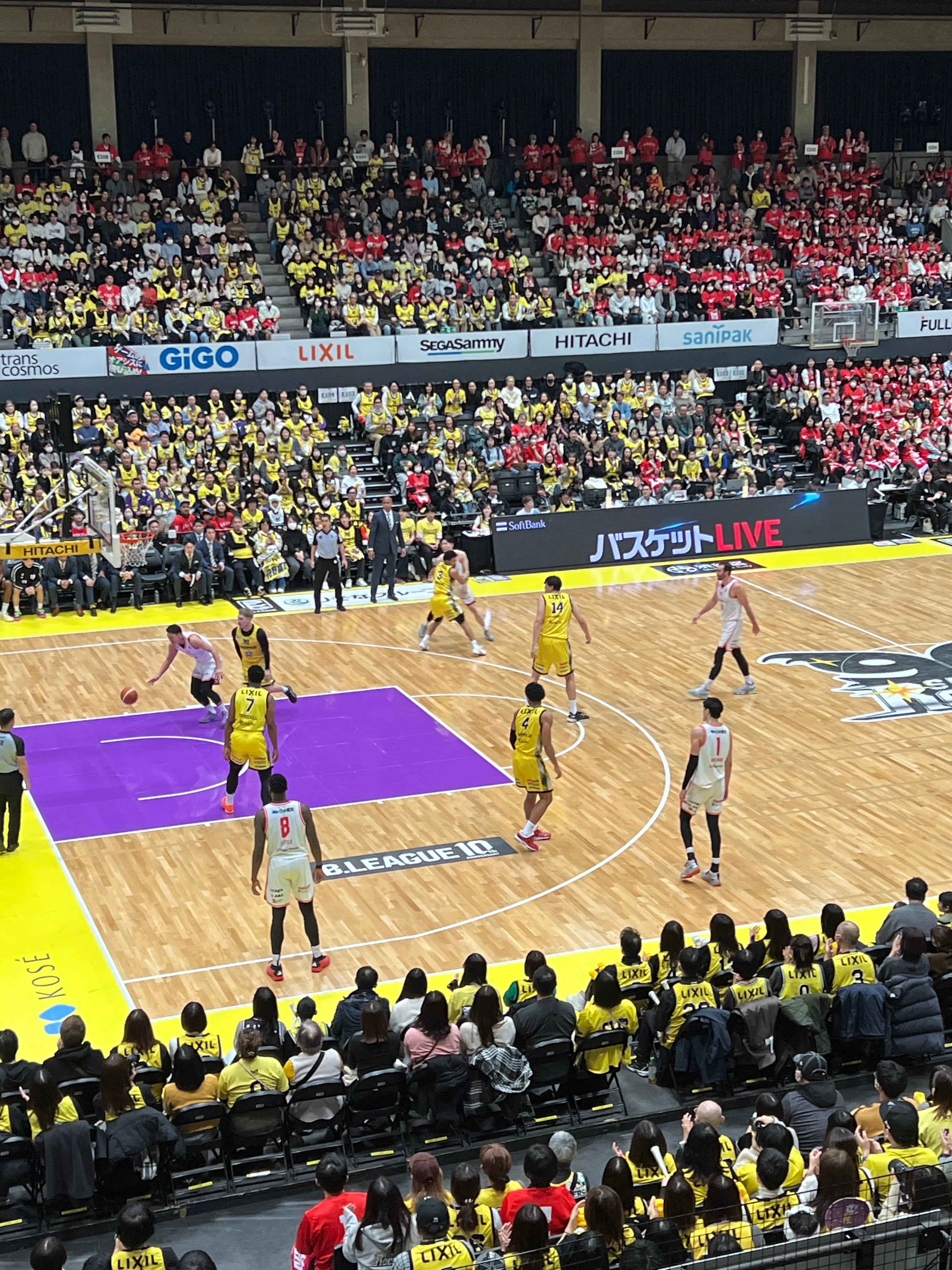
One afternoon in Tokyo, I was taking a meandering walk in the general direction of a museum I planned to visit, when I came across a big banner promoting a basketball game between the Shibuya Sun Rockers and the Chiba Jets. The game was that evening, two hours away, and people in Shibuya yellow and Chiba red were already starting to line up outside the arena. Never one to miss a clear sign from the sports gods, I beelined to the box office, contemplating how much I’d be willing to pay for courtside seats, only to learn that tickets were sold out. It took some pleading and persistence, but I managed to get a standing room spot next to the TV camera guys at the top of the packed stands, behind the hometown Shibuya fans, who chanted and sang and complained about the referees.
The sports gods blessed me that day. Of all the games to wander into, this one featured Japan’s best player, Yuta Watanabe, a star forward on the Jets and the national team that qualified for the 2024 Olympics, and he decided to put on a show for us. He’d played in the NBA for several years, and his world-class skills tore up the Sun Rockers defense. Cross-over step-back threes, hesi mid-range pull-ups, freight-train dashes to the rim, whipping the Chiba side into a frenzy, deflating Shibuya supporters into awe-struck resignation. I knew the feeling, had seen my own teams cut down by the wizardry of Lebron James and Patrick Mahomes, an experience as magical as a nightmare. Sitting on Shibuya’s side, I maintained proper decorum, hiding my glee as Watanabe soared for another spectacular dunk.
**
Around the world, across cultures and classes, a similar set of rituals plays out, ceremonies celebrating beloved games. I wrote about the universal language of sports for Condé Nast Traveler’s series on countries in this year’s World Cup, which kicked off this week. My contribution is a snapshot of beach football in Cape Verde.
**
Back in the States this spring, I’ve been covering the Knicks’ magical playoff run. In recent weeks, I’ve written about Spike Lee’s local sports bar and Victor Wembanyama’s arrival as New York City’s latest sports villain. This week, I wrote about Knicks fans booing Donald Trump when he attended Game 3 at Madison Square Garden and the raucous celebrations out in the streets after the team’s miraculous Game 4 comeback.